Howie Singer and Larry Miller spent two years building a2b Music inside AT&T. They were two weeks from freedom when corporate killed the spin-out. Two weeks later, Napster proved that the demand for unfettered access to the world’s music was enormous.
Two Weeks
James D. Johnston, known to colleagues as JJ, spent 26 years at Bell Labs building the perceptual audio coding technology that became MP3. A federal appeals court would later state that he and Karlheinz Brandenburg together created the MP3 standard. His story is told in “The Other Father of MP3,” the companion piece to this article. But this isn’t his story. This is the story of what happened on the business side.
JJ saw it from the lab. They told him nobody would ever sell music over the internet. The technology he’d spent years building was killed by executives who couldn’t see the future even when it was sitting on their desks.
But that’s not the whole story.
While JJ was being told the technology had no future, two people on the business side were trying to prove the executives wrong. Howie Singer and Larry Miller had built a2b Music into a functioning digital music service with label partnerships, a download platform, and the best audio codec in the world. They had a plan to spin it out of AT&T, take venture funding, and compete in the emerging digital music market.
They almost made it out.
In May 1999, AT&T cancelled the spin-out. Singer, Miller, and ten colleagues left for a competitor called Reciprocal. The Wall Street Journal covered the exodus. An AT&T executive dismissed them: “Two individuals do not make a business.”
Two weeks later, Napster launched.
Four years after that, Apple launched the iTunes Music Store using AAC. The codec AT&T had developed and abandoned. The technology won. AT&T lost. And Howie Singer and Larry Miller were left wondering what might have been.
The Vision
In February 1999, the New York Times ran a story on the front page of its Business Day section about the recording industry’s scramble to catch up with the internet. The photo showed guitarist Billy Squier demonstrating software that could deliver his recordings over the internet. Sitting at the keyboard next to him was Howard Singer, explaining how it worked.
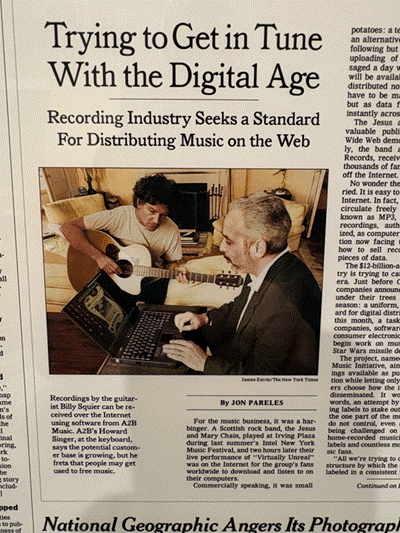
The Times caption noted that Singer “frets that people may get used to free music.” Singer’s worry was prescient. Every day that passed, more people were getting comfortable not paying for music. The window for legitimate digital distribution was closing.
But a2b had something nobody else did: the technology JJ had built at Bell Labs. While competitors like Liquid Audio were using inferior codecs, a2b had access to AAC. Perceptual audio coding that sounded better at lower bitrates. They had the Rock and Roll Hall of Fame jukebox, 30,000 tracks streaming at near-CD quality, with visitors asking the same question over and over. Singer describes it:
“There is a jukebox at the Rock and Roll Hall of Fame with every song from every inductee. When you press the touch-screen, every song by Bob Dylan is there. There’s 30,000 songs in total. Everyone who sees it says, ‘When can I get this in my house?’ Basically, it’s the celestial jukebox, and people line up to use it.”
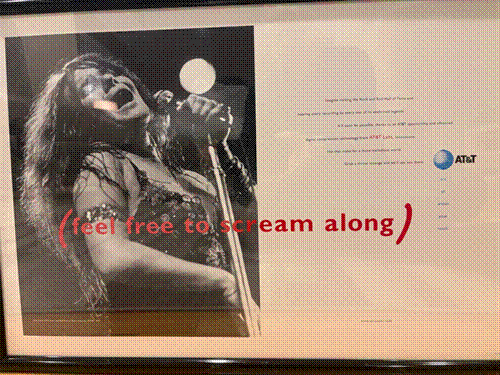
AT&T was so proud of the Rock Hall project that they ran national advertising featuring Janis Joplin and the tagline “feel free to scream along.”
When George Michael Came to Bell Labs
Rock stars did not visit AT&T Labs in Florham Park, New Jersey. The sprawling research campus was home to engineers and scientists, not entertainers. But a2b was building something that artists cared about, and having musicians themselves support the platform was clearly a plus.
George Michael’s manager had expressed interest. Singer arranged a visit and demo at the Labs, where Sandy Fraser, James Johnston, and the rest of the a2b technical team had their offices. When Singer checked George in at the front desk, the security guard was visibly taken aback. This was not a typical visitor.
After the demo, Singer went outside with George so the singer could have a cigarette. They stood in the New Jersey parking lot, talking about the future of music distribution. George was genuinely engaged with the technology and the vision behind it. George’s manager later offered to make George Michael the public face of a2b Music.
The endorsement came with a multi-million dollar price tag. Nothing ever came of it. But the visit illustrated what a2b had built: something compelling enough that one of the biggest pop stars in the world wanted to understand it, and serious enough that AT&T Labs was willing to host him.
Sidebar: Two Products, One Vision
a2b Music was actually two distinct products working in tandem: desktop software for buying and playing music, and portable hardware for taking it with you. Understanding this distinction helps explain both a2b’s ambition and why the labels found it so threatening to their enormously profitable CD business.
The a2b Music Player (Desktop Software)
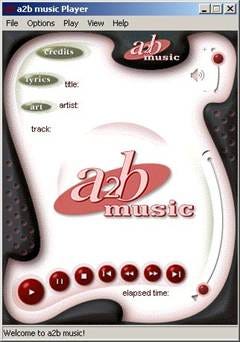
The desktop player was free software for Windows that let consumers purchase, download, and play AAC-encoded music files. It supported both downloads (stored as .a2b files) and streaming (which required RealPlayer). The DRM was built into the file format itself, tying purchases to specific machines. Version 1.02 shipped in June 1998; version 2.0 followed in April 1999.
The AT&T FlashPAC (Portable Hardware)
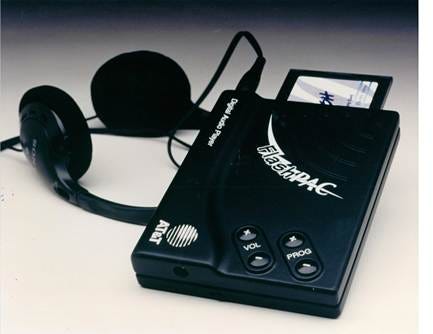
The FlashPAC was AT&T’s answer to the emerging portable player market. It used PC Card (PCMCIA) flash memory cards, which were more expensive but offered larger capacities than the SmartMedia cards used by competitors. The device could store and play a2b-protected files transferred from the desktop software. This was the product that made record labels most nervous: once music could leave the PC, the potential for unauthorized copying multiplied.
The Emerging Portable Player Market
The FlashPAC was entering a market that barely existed. The first mass-produced portable digital music player was the MPMan F10, released by South Korean company SaeHan Information Systems in March 1998. It featured 32MB of flash memory (roughly 6-10 MP3 songs) and connected via parallel port. But it was the Rio PMP300 from Diamond Multimedia, released in September 1998, that brought portable MP3 players to mainstream attention, prompting a lawsuit from the RIAA that the company ultimately won.
The FlashPAC’s key differentiator was supposed to be legitimacy: unlike the Rio, which played pirated MP3s, the Flashpac would only play properly purchased, DRM-protected a2b files. AT&T believed this would make the labels comfortable with portability. They underestimated how deeply the labels feared any device that undermined the CD and moved music off the PC, regardless of DRM.
a2b depended on two pieces of AT&T technology: AAC for the audio, and a security system for digital rights management built by Dave Maher and Jack Lacy. Both later became executives at Intertrust. When pitching the labels on how secure their system was, they had a compelling credential: Maher had designed the secure telephone on the President’s desk.
This wasn’t a skunkworks project. It was a major corporate initiative with label partnerships, consumer advertising, and technology that worked. Larry Miller told the New York Times in November 1998: “We’re going to change the way you buy, and play, music.”
He wasn’t wrong. He just wasn’t going to be the one to do it.
The Permission Culture
To understand why a2b failed, you must understand what it was like to run an internet startup inside a telephone company.
Singer remembers one early project with a major label to distribute a song over the internet. Before they could proceed, AT&T’s legal team needed to approve the lyrics to ensure they wouldn’t harm the AT&T brand. Singer recalls:
“I literally typed the lyrics of the entire song into a document for AT&T to clear. As there were no lyric databases then, I had to do it by hand. Of course the irony is that a few years later the AT&T brand was associated with cable channels that provided very adult movies and shows.”
This was the permission culture that was strangling a2b. Every decision required approval. Every partnership needed legal review. Every song lyric had to be cleared for brand safety. While competitors moved at internet speed, a2b was trapped in the bureaucratic rhythms of a century-old telephone monopoly.
Larry Miller describes what this meant in practice. AT&T at the time was constrained by what he calls a “highly controlled business innovation process,” one that was more about “liability control” than supporting innovative ideas. The company simply did not support or reward entrepreneurial behavior.
Singer and Miller knew they couldn’t compete this way. Their competitors, Liquid Audio and MP3.com, were raising venture capital and moving fast. The only path forward was to spin out of AT&T, take outside funding, and operate as an independent company. As Miller puts it:
“We needed to work at ‘Internet speed’ and that was decidedly not how AT&T operated.”
The spin-out had support from AT&T Labs. Sandy Fraser, the legendary Bell Labs executive who had championed the technology, was behind it. Fraser would remain a champion of the project until the end and beyond. David Nagel, head of AT&T Labs and himself a former Apple executive, was supportive. Albert Chu, VP of Technology Transfer, kept the funds flowing and ensured they had engineering resources.
Singer and Miller were told to act as entrepreneurs, and they took that to heart. They wanted to follow the Silicon Valley approach. A spin-out that would recognize their sweat equity and give the team stakes in the business. They pitched it to both the business leaders and the Labs executives. They received approval to proceed.
AT&T assigned an experienced M&A executive to work with them and lead discussions with potential investors. Allen & Co, which had a strong relationship with AT&T, was in substantive discussions. They brought on Jim Kuster, a technology banker from Chase, as an advisor specifically to assist with the financing side of the spin-out. New team members were hired as contractors rather than AT&T employees, specifically to make the spin-out transition easier.
Going All In
Singer had worked at AT&T for twenty years. He was nowhere near retirement age, but the company offered an early retirement package that would allow him to prepare for the transition to the new company. The spin-out seemed likely but was not guaranteed. And at the time he signed the papers, there was no safety net. Reciprocal wasn’t even contemplated yet.
Before making the decision, Singer went to Albert Chu. He told Chu he was betting that the spin-out would happen. He was going “all in” on continuing to work in digital music, and he had decided to move on from AT&T regardless of what happened. Chu told him he could take the retirement package and continue to work on a2b music. So Singer took the leap.
David Nagel was not happy to hear about Singer’s decision. Nagel’s knee-jerk reaction was that if Singer didn’t want to be part of AT&T, he should stop working on a2b music immediately. Singer wrote him an email explaining his thinking and the fact that he had discussed everything with Albert. Chu backed him up and smoothed things over with Nagel.
Singer personally negotiated agreements drafted by AT&T Legal that would be executed at spin-out. Rights to the software and patents, the brand and logos, the contractor agreements, the business deals with music companies, even the lease on their Madison Avenue office space. Most remarkably, AT&T Labs agreed to continue serving as the R&D team for the spun-out company. Singer describes this arrangement as “highly unusual” and a sign of how much the Labs believed in the project.
They also brought in outside expertise to help with the music business side. Ken Krasner and Marc Schiller, founders of Electric Artists, were brought in as “music business emissaries” to help operationalize technology projects on the music business side. Wayne Rosso, a music business publicist, was hired as a consultant. (In one of those ironic twists that characterize this era, Rosso would later become the president of Grokster, a Napster clone.)
Everything was in place. The spin-out was planned for mid-1999.
Then Ed Chatlos, the business executive who had been shepherding the project, was given a bigger job. Responsibility for a2b transferred to someone new.
The Kill
Mercedes Walton was AT&T’s Vice President of Corporate Strategy and Business Development. She had no background in music and no relationships in the industry.
Walton wasn’t irrational. Her logic was straightforward: why spin this out and give away equity in something AT&T could own outright? She was convinced AT&T could own the online distribution space itself. She persuaded the higher-ups that keeping a2b inside the company was the right strategy.
What she didn’t understand was that the music business is, perhaps even more so than other industries, a relationship business. Those relationships and the attendant trust were needed to persuade an industry to make changes it was resisting. Walton let the people who had built those relationships walk out the door.
Singer knew they were in trouble when Larry Miller’s performance review said he was being “too entrepreneurial.”
Miller remembers the moment clearly. “We received no indication that we were ‘too entrepreneurial’ or that the project would not succeed until Mercedes Walton was given operational oversight of a2b music.” If there is one person to attribute the termination to, Miller says, it would be Mercedes Walton.
The decision likely never reached CEO Michael Armstrong. Miller believes it was made at levels below Armstrong, possibly by John Petrillo, to whom Walton may have reported at the time. The spinout was cancelled. There’s a bitter irony here: AT&T had created Miller’s role precisely because the company kept fumbling its own innovations. Digital photography, cellular technology, countless Bell Labs breakthroughs that competitors commercialized first. Miller was supposed to prove AT&T could do it differently. He wasn’t even in the room when they decided not to.
On May 18, 1999, the Wall Street Journal reported the aftermath:
“A2B managers had been pushing AT&T to spin off A2B, in part to let the founders profit from the company they had been building, according to people familiar with the matter. But AT&T concluded it wanted to retain control of the business.”
Walton’s quote to the Journal was dismissive: “Two individuals do not make a business.”
Singer’s reaction, decades later, still carries an edge:
“I remember thinking at the time that I guess she never heard of Alexander Graham Bell or Jobs and Wozniak. Not presuming to compare us to them, of course, but to point out the absurdity of her statement.”
Walton went on to have a successful executive career, holding several high-level positions after AT&T including in biotech. She was putting forward what she thought was the right strategy. She was wrong about what made the music business work.
The Escape to Reciprocal
Singer and Miller knew it was over. Once the spin-out was squelched, they started working on an alternative. But contrary to what some have assumed, they didn’t seek out Reciprocal. Reciprocal came to them.
A banker named Cliff Friedman, who ran a fund called Constellation Ventures, reached out. Constellation had invested in the early internet music space and was looking for opportunities. Friedman’s fund was what Miller describes as “strategic VCs,” different from firms like Hummer Winblad, which had funded Liquid Audio.
Miller got a phone call from Paul Bandrowski, the CEO of Reciprocal and a Constellation portfolio company, while Miller was in Colorado. Bandrowski and Friedman pitched the idea of the a2b team joining Reciprocal to run its entertainment and music division.
Reciprocal had an interesting history. It was originally named SoftBank Network Solutions, being a SoftBank portfolio company. The company was founded by entrepreneurs Jordan Levy and Ron Schreiber, who became key drivers in both Reciprocal’s formation and the a2b team’s move. By 1999, Reciprocal was on track to go public and had raised roughly $100 million from high-level VCs, private equity firms, institutional investors, and strategic partners. Fred Wilson from Flatiron Partners, who Miller describes as “the most prominent VC in New York at the time,” was among the investors.
The allure of Reciprocal was precisely that it was, in Miller’s words, a “properly structured, properly funded, bias toward action” business where they were “expected to break some eggs on the way to making an omelet.” This was exactly what AT&T abhorred.
They told AT&T about the negotiations. Initially, the separation was amicable. AT&T even agreed to transfer the NYC office lease to Reciprocal.
Then the press coverage hit.
The Los Angeles Times: “Demonstrating the difficulty of a mega-corporation’s fostering an entrepreneurial venture, more than a dozen members of AT&T Corp.’s A2B music have left.” Reuters: “This is absolutely a setback for AT&T... the two most visible faces to the industry were Howie and Larry.” Daily Variety: “The loss of two key execs will probably stymie AT&T’s efforts.”
AT&T was convinced Singer and Miller were feeding the criticism to the press. They stopped playing nice. They threw the team out of the offices.
Twelve of twenty-six employees left for Reciprocal. Chris Varley was assigned to replace Larry. The Labs engineers continued developing the software, and AT&T pursued Project Nigel with Universal Music Group, BMG, and Matsushita. The strategy was to use AT&T’s cable systems to ship “soft goods” like music.
But the pipeline of projects with the labels slowed down. The people who had pushed for those things and had the relationships were gone. “a2b music sort of died a slow death,” Singer says. AT&T shut it down completely in 2002.
A Second Chance
The best feeling about Reciprocal was that here was a well-funded company, with that SoftBank and Microsoft money, that really wanted them. But the company had been concentrating on being a software services company for e-books and publishing. Before the a2b team arrived, Reciprocal was based solely in Buffalo, NY, and their digital clearinghouse was in an old bank building. They were a startup, but they were not familiar with the entertainment and music space. That’s why their executives and investors wanted the a2b team. And they were not accustomed to the pace that the now-transferred a2b music team operated at. That may have been as much about the cultural differences between New York City and Buffalo as anything else.
The Reciprocal tagline was “Driving the Content Economy.” After pushing the Buffalo team hard to complete the work to support a specific music project on a very tight schedule, Linda Seigelman, another AT&T manager with a marketing background who became part of the a2bmusic team and then Reciprocal’s team made thank-you t-shirts that read: “Driving the Content Economy — 24/7.”
They wanted to have music from a major label artist for their first digital music trade show booth as Reciprocal. Larry went to Kevin Conroy, an exec at BMG responsible for their digital efforts. They wanted one of BMG’s successful artists for obvious reasons. Conroy decided to give them music from a new artist who he assured them was going to be big. Beggars can’t be choosers, so they said yes. They played the hell out of the music video of “Genie in a Bottle” by Christina Aguilera in the booth and used her song in their demos. Conroy was right about her future.
Reciprocal was preparing its S-1 for an IPO. It was hard not to think of the Reciprocal shares they had been granted as being worth what could have been millions. The company was not yet profitable but had millions in revenues, some of it from consulting on digital distribution strategy to media companies. John Schwarz, an IBM veteran and brilliant technology executive, was brought in as CEO specifically to take the company public.
Then the dot-com bubble burst in March 2000. The IPO never happened.
The End of Reciprocal
The dot-com bust didn’t kill Reciprocal immediately. The company decided to raise another round of funding, and Microsoft agreed to come in as the lead investor.
Then September 11, 2001. Singer watched the video of the plane hitting the second tower on the screen in the elevator at 330 Madison, on his way up to the Reciprocal offices.
After 9/11, no one else was willing to open their checkbooks. The company lowered its burn rate to try to survive until things loosened up, cutting back on people and expenses. They were committed to having a booth at a digital trade show in Los Angeles, and the Reciprocal leadership, after conferring with Microsoft, said go ahead.
So Singer flew out. As one of the remaining employees, he stood at the booth making the pitch that despite the tough times and rumors to the contrary, Reciprocal would still be around going forward.
Then he got a call. The efforts to find additional VC money were being abandoned. Reciprocal was shutting down entirely. He should fly home.
It was a depressing flight. But it was clear that this run was over. Reciprocal had an asset sale to Microsoft shortly after.
Singer ended up consulting for Rightscom for most of 2002 as their one-man New York “office” with plans to expand. (Rightscom is the UK-based firm that runs the DDEX standards today on behalf of the music industry.) By summer 2002, it was clear the expansion plans weren’t going to pan out. He started looking for jobs in the music business and applied to become the CTO at Warner Music Group, along with one thousand other people. The fact that WMG people already knew him helped in the process. He started there right after Thanksgiving 2002. Singer would serve as Chief of Strategic Technology at WMG for ten years. Today he teaches graduate music analytics at NYU.
The road from a2b to Warner had taken three and a half years and two dead companies.
The Two Weeks
On June 1, 1999, fourteen days after Miller and Singer walked out of AT&T, an eighteen-year-old named Shawn Fanning launched Napster from his uncle’s office in San Mateo, California. Singer recalls:
“No one in the music industry, within AT&T or any of the labels, had a clue at the time about how fast Napster would take off on campuses. The threat was clear by early 2000.”
“Napster blindsided everybody,” Miller confirms. Visibility into what Napster was about to unleash would have created more urgency for the message the a2b team was trying to convey within AT&T and the music industry.
The timing is almost unbearable to contemplate. If the spin-out had happened as planned, a2b would have been positioned as a strong alternative backed by AT&T and its competitive technology, alongside Liquid Audio, just as Napster was terrifying the record labels into action. Instead, the team that understood digital music better than anyone was scattered, the technology was orphaned inside a company that didn’t know what to do with it, and the labels spent the next four years flailing.
Ted Cohen was there for all of it. As a consultant, he had relationships across the entire industry. He was working with Napster, Liquid Audio, the RIAA, Amazon, and twenty other clients simultaneously. In September 1999, three months after Napster launched, he visited their offices in San Mateo. Cohen recalls:
“I walk into what was the conference room, and sleeping on the floor are Sean Parker and Shawn Fanning. Shawn Fanning is using a motorcycle helmet as a pillow. Sean Parker was using his blue jean jacket as a pillow.”
Two kids sleeping on the floor. This was the competition that had just blindsided an entire industry. Interestingly, Hummer Winblad, the VC firm, was initially the lead investor for both Liquid Audio and Napster, placing bets on both the legitimate path and the disruptive one.
Cohen would later join EMI as VP of New Media, where he spent six years navigating the same industry politics that had killed a2b. He knew Singer and Miller. Had known Larry since his days as program director at a smooth jazz station in New York. When asked about a2b’s failure, Cohen’s assessment was blunt:
“a2b didn’t fail because of them. It failed because you had two really smart, creative people dealing with a corporate structure in New Jersey that said they wanted to get into it, but didn’t want to really get their hands dirty.”
Cohen describes himself as a “forgiveness executive, not a permission executive.” Someone who acted first and apologized later. He faked McKinsey reports to get deals approved at EMI. He gave startups “EMI permission” letters without any authority to do so. He called a2b and Liquid Audio “too early and too nice.”
Sidebar: The Ted Cohen Masterclass
Ted Cohen’s career offers a masterclass in navigating fragmented industries through relational intelligence and calculated audacity. His approach is worth studying not because it’s ethical, but because it reveals how power actually flows in moments of disruption. Here are the lessons:
1) Be interested in everything. Cohen consulted for Napster and the RIAA simultaneously. For Liquid Audio and Amazon. For labels and startups. He joked that he had “no conflict of interest” because he was “interested in everything.” This wasn’t just mercenary consulting. It was intelligence gathering. He understood every player’s position, every deal’s structure, every negotiation’s pressure points. When he needed to make something happen, he knew exactly which levers to pull.
2) Create facts on the ground. When EMI’s global deal committee asked what McKinsey thought of the Rhapsody proposal, Cohen spent a week writing a five-page “McKinsey overview” and presented it as a preview of a larger report. The deal got approved. When startups needed legitimacy, he gave them “EMI permission” letters without any authority to do so. He understood that in large organizations, momentum matters more than authorization. Once something is moving, stopping it requires effort that most bureaucracies won’t expend.
3) Know the difference between recoverable and catastrophic risk. This is the crucial distinction that separates Cohen’s approach from what a2b could have done. Cohen was gaming internal corporate politics. If caught, the worst outcome was termination. Embarrassing, career-damaging, but recoverable. For a2b to “stop being nice” would have meant distributing music without permission. The worst outcome was a copyright lawsuit. That’s not a career setback. That’s an existential threat. Cohen could play forgiveness-not-permission because his transgressions were internal. A2b’s only path to that approach would have been Napster’s path: break the law and hope you survive.
4) Make yourself central. Cohen positioned himself at every intersection of the emerging digital music industry. He was the person who knew everyone, who had been in every room, who understood every deal. This wasn’t just networking. It was strategic positioning. When decisions needed to be made, he was the one people called. When deals needed to happen, he was the one who could make introductions. His value wasn’t expertise. It was access.
The Ted Cohen approach works in moments of transition when old rules are dissolving and new ones haven’t solidified. It requires a particular personality: someone comfortable with ambiguity, willing to take personal risks, and skilled at reading organizational dynamics. Not everyone can do it. But for those studying how disruption actually unfolds, his career is an invaluable case study in the difference between what organizations say they want and what they actually reward.
Three Perspectives on “Too Nice”
Cohen’s “too nice” assessment has become a common framing of a2b’s failure. But Singer and Miller push back on this characterization, revealing a fundamental difference in risk calculus.
The worst that could have happened to Ted Cohen for faking documents was getting fired. EMI wasn’t going to sue their own VP for copyright infringement. He was playing internal corporate politics. High stakes personally, but recoverable.
For a2b to “stop being nice” would have meant something entirely different. Singer explains:
“For either Liquid Audio or a spun-out a2b music to ‘stop being nice’ would have required us to copy and distribute music without permission or not to keep our promises as to how their music would be treated/used and then to seek forgiveness, typically after getting sued, like mp3.com. Or Suno and Udio now. Not all investors want to take that risk.”
Miller agrees with Singer’s framing. Operating on “the world’s biggest telecommunications platform and brand” like AT&T allowed very little “operating flexibility” compared to companies that “shoot first and ask questions or permission later.” Cohen was gaming internal bureaucracy. A2b would have had to break the law.
But there’s a counterpoint. Apple was also a big company, and Steve Jobs managed to use Apple’s power to push boundaries in ways that AT&T never would. Apple proved that might makes right.
The difference, as Miller sees it, comes down to leadership. AT&T’s corporate culture prioritized risk avoidance over market opportunity. Reciprocal offered the opposite: a startup environment where moving fast was expected, not punished.
The tragedy of a2b isn’t that they were too timid. It’s that they were trying to build a legitimate business at precisely the wrong moment in history. The market wasn’t ready for legitimacy. CDs were still printing money. 1999 was the peak: $14.6 billion in US revenue. Tower Records was packed every weekend. Why would Universal or EMI make a serious deal with anyone trying to cannibalize that?
The labels hadn’t been terrorized yet. They hadn’t watched their business model collapse in real-time. They hadn’t felt the existential panic that would eventually make them sign whatever terms Steve Jobs demanded. In 1999, digital music was a curiosity, not a threat. The labels could afford to be difficult, to drag their feet, to demand impossible terms. They had no urgency to cooperate with the “nice guys” because there was no crisis forcing their hand.
Singer is clear-eyed about what would have been required:
“That’s why I said there was no guarantee we would succeed. We needed the Napster impact to convince the labels that they needed to do a bigger deal with the ‘nice guys.’”
The spin-out was necessary to escape AT&T’s permission culture. But escaping AT&T wasn’t enough. Success required something a2b couldn’t control and couldn’t create: a crisis. They needed Napster to terrorize the labels into cooperation. The “nice guys” needed the “bad guys” to burn the village before the villagers would accept help rebuilding.
This is the cruel arithmetic of disruption. Being right isn’t enough. Being early isn’t enough. Being legitimate isn’t enough. You need the incumbents to be scared, and in 1999, they weren’t scared of anything except losing their CD margins.
By the time that crisis arrived, a2b was gone.
The Road to iTunes
The labels spent the next four years learning the hard way that they couldn’t do digital music themselves.
Universal created Bluematter, a download store where you had to know to go to Universal’s site to find Elton John. Warner and EMI backed MusicNet, a service powered by RealNetworks. Universal and Sony created Pressplay. If you searched for Madonna on Pressplay, it said “Artist Not Found.” Madonna was on Warner, and Warner was on the competing service.
Cohen watched it happen from inside EMI:
“Instead of pointing, saying, ‘Well, we don’t have it, but it’s over on Pressplay. Here’s a link. Go get it, then come back to us.’ It was stupid. We never were good at being in retail, physical or digital.”
Then Steve Jobs called.
Apple had launched the first iPod in October 2001. By 2002-2003, Jobs was preparing to announce iTunes and held semi-public meetings with both major and independent labels.
Miller was there. After the Reciprocal era, he had founded a record and music publishing company called OR Music in early 2002, which found success with the artist Los Lonely Boys. In 2012, he became a professor at NYU and served as director of the music business programs for eleven years. He is now inaugural director of the Sony Audio Institute for Music Business and Technology at NYU. He attended Jobs’ indie label meeting. Miller recalls:
“I was hypnotized by Steve.”
The iTunes Music Store launched in April 2003, using AAC. The codec AT&T had developed. The technology JJ built. The format a2b had championed. Jobs had what a2b never did: leverage. The iPod was already a hit. The labels were desperate after four years of Napster-driven revenue collapse. And Jobs had a reputation that made executives want to be in the room with him.
Paul Vidich, the senior business development person at Warner Music Group at the time, negotiated with Jobs for the initial iTunes launch on behalf of the majors. Miller describes him as “the smartest guy in any of those rooms.”
But even the smartest negotiator couldn’t fully contain Jobs. Cohen’s account of dealing with Apple is revealing. Jobs would agree to terms in a contract and then simply refuse to honor them:
“Steve Jobs was worse to deal with than any ‘pirate’ music company, any corporate entity. If Steve said it was a deal, it means he’s agreeing to it in the contract, but he will probably renege or violate the contract, and then what are you going to do about it? It’s Steve Jobs.”
EMI had negotiated for anonymous aggregate behavior data. Nothing identifying, just patterns that would help them understand how people were buying music. Six months in, Cohen called Eddy Cue, Jobs’ deputy running iTunes, to ask about starting the data feed:
“He goes, ‘Oh, yeah. That you’re never getting.’ I said, ‘What do you mean? It’s in the contract?’ He goes, ‘Yeah, I know we agreed to it, but we have no intention of giving it to you.’ I said, ‘What are you talking about?’ He goes, ‘You know, you’re right. We’re in breach of contract. I think you should sue us, and when it comes to court in three or four years, you’ll probably win. But until then, we’ll stop selling EMI’s music.’”
Cohen brought this to Alain Levy, the chairman of EMI. The response: “Don’t upset them. It’s not that big a deal.”
The labels accepted behavior from Apple they never would have accepted from a2b. Contract violations, broken promises, dictatorial terms. But Jobs had leverage and a2b didn’t. The technology was the same. The power dynamics were completely different.
Miller credits Apple’s actions as an important mitigating force during what he calls “a decade of destruction of value in the music industry.” But he also offers a sobering observation about the path that led there:
“The road to streaming ubiquity is paved with the husks of dead companies who had in many cases the music industry’s best intentions at heart.”[1]
What the Record Shows
Singer has thought carefully about what might have happened if the spin-out had succeeded. Singer’s assessment is honest:
“There was no way our success would have been assured. MP3 was making huge strides because it had no restrictions in terms of the user experience. And the labels even in the early 2000s with Musicnet and Pressplay insisted on rules that constrained the services and made them consumer unfriendly. Those failures and the continued revenue declines set the stage to agree to the Apple terms in 2003.”
Could an independent a2b have persuaded the labels to loosen restrictions before Apple forced their hand? Singer says fifty-fifty. “But wish we had the chance to try.”
Could the FlashPAC prototype have competed with the iPod? Lower odds. “But again it would have been worth a shot.”
Could they have built an integrated system of software and hardware that worked seamlessly? Perhaps. “But surely not as elegantly as the iPod and iTunes.”
Could they have persuaded the labels to compete with file-sharing on campus by implementing a streaming jukebox? No chance. “At least for several years. Though history shows it would have been a strategically smart move.”
The real tragedy isn’t that a2b would definitely have won. It’s that they never got a fair chance to find out. Reciprocal was their second shot, but the dot-com crash took that away too.
Ted Cohen, who watched the whole arc unfold from his perch at EMI, identified a pattern that repeated at every transition in digital music:
“At every one of these turning points, somebody was worried about pissing off whoever the incumbent big dog was. Tower and Best Buy and Sam Goody, whatever the current infrastructure was would be somewhat disrupted by the new player.”
Nobody wanted to do a deal with Amazon because it would upset Tower Records. Nobody wanted to do a deal with iTunes because it would upset Amazon. Nobody wanted to do a deal with Spotify because it would upset Apple.
And in 1999, nobody at AT&T wanted to let a2b spin out. Because Mercedes Walton thought AT&T could own the online distribution space? Because giving equity to employees felt wrong to a company with no Silicon Valley tradition? Because two individuals don’t make a business?
Singer still doesn’t know exactly who made the final decision or how hard the Labs pushed back. Miller believes it never reached Armstrong. He believes the decision was made at levels below him. But Miller hasn’t shared his notebooks from that era. The ones he says he hasn’t looked at this century.
What we know is this: AT&T had the technology, the team, the label relationships, and a plan to compete in digital music. They killed it two weeks before Napster proved that the demand curve for downloadable music looked like the mother of all hockey sticks. Four years later, Apple built a $40 billion business on the foundation AT&T had abandoned.
James Johnston heard it from the executives: “Nobody will ever sell music over the internet.”
Howie Singer saw it from the business side: “Wish we had the chance to try.”
They were both right. And they were both too early, trapped inside a company that couldn’t move at internet speed and wouldn’t let them leave to try on their own.
The permission culture won. The technology lost. And somewhere in a museum, a FlashPAC prototype sits in a display case. A reminder of the iPod that could have been, built three years too early by people who saw the future and weren’t allowed to chase it.
The Business Lesson: How Disruption Actually Works
The a2b story reveals a pattern that has repeated across every major media transition: the companies that succeed in disruption are never the ones who ask for permission.
Consider the three paths that emerged from the late 1990s:
1) Napster took the outlaw path. Shawn Fanning and Sean Parker, sleeping on the floor of a San Mateo office, built a service that gave people exactly what they wanted: all the music in the world, instantly, for free. They never asked the labels for permission. They never negotiated licensing deals. They simply built the thing and let 20 million users prove the demand existed. The music industry sued them into oblivion, but not before Napster had permanently altered consumer expectations. People now knew what was possible.
2) Apple took the leverage path. Steve Jobs did not go to the labels in 2001 saying “please let us sell your music.” He built the iPod first. He created a beautiful piece of hardware that people desperately wanted to fill with music. Only after the iPod was a hit did he approach the labels, and by then his negotiating position was unassailable. The labels needed him more than he needed them. Jobs could dictate terms because he had already built the consumer relationship.
3) a2b tried the partnership path. Singer and Miller attempted to build a legitimate digital music business with label cooperation, inside a corporation that required permission for everything. They had better technology than anyone. They had real relationships with the industry. But they were asking the labels to embrace a future that threatened their present. And they were doing it from a position of weakness, as employees of AT&T, without leverage, without a consumer product that had already proven demand.
The lesson is more nuanced than “permission culture always fails.” The evidence in this story shows something different: permission culture is fragile. a2b was working. They had the technology, the deals, the team, the internal champions. Armstrong gave implicit support. Nagel believed in it. The strategy was succeeding. Then one person who didn’t understand the relationship business made a unilateral decision, and it all shattered.
That’s not proof the strategy can’t work. That’s proof it’s a glass cannon: high potential, high fragility. One bad actor in the chain of command can destroy everything. The real lesson for anyone trying to build something inside a large organization is this: if you’re going to play the permission game, you need to control, or at least survive, every node in the approval chain. Singer and Miller couldn’t protect themselves from a new hire who didn’t know what she didn’t know.
Napster didn’t have that vulnerability because Napster wasn’t asking anyone’s permission. Apple didn’t have that vulnerability because Jobs WAS the chain of command. Netflix built subscriber scale before negotiating with Hollywood. Spotify launched in Sweden, proved the model, and forced the labels to come to them. TikTok built the audience first and made the music industry adapt. These companies succeeded not because “move fast and break things” is the only path, but because they had no single point of failure where one uninformed executive could kill the whole thing.
The music industry spent the years from 1999 to 2003 learning this lesson the hard way. Their own attempts at digital music, MusicNet and Pressplay, failed precisely because they were designed to protect the old business rather than serve the new consumer. They succeeded only when they surrendered to someone with leverage: Steve Jobs, a man who would break contracts and dare them to sue.
For anyone watching the current fragmentation of streaming video, or the emergence of AI-generated content, or any other media transition on the horizon, the a2b story offers a warning, but not the obvious one. The lesson isn’t that you must break things to win. The lesson is that permission-based strategies are viable but fragile. They can work brilliantly right up until they don’t. And when they fail, they fail completely, because you’ve built your entire structure on approvals that can be revoked by people who don’t understand what they’re revoking.
Singer and Miller understood the fragility. That’s why they fought so hard for the spin-out. They knew that staying inside AT&T meant staying vulnerable to exactly what happened: one person, one decision, one moment of ignorance collapsing two years of relationship-building and deal-making. The spin-out would have removed that vulnerability. They almost made it out. And two weeks after they didn’t, an eighteen-year-old in San Mateo demonstrated what a business looks like when there’s no one left to ask for permission.
About
Frans Keylard is a Digital Marketer, an occasional technology writer, and former host of The Rogues’ Gallery podcast. This article was developed through interviews with Howie Singer, Larry Miller, and Ted Cohen, and verified against court documents, news archives, and contemporaneous sources.
[1] The author experienced this firsthand. From 2004–2007, while producing The Rogues’ Gallery I also operated weedstash.com as an Independent Content Provider for Weedshare, a Seattle-based “superdistribution” service. ICPs encoded and hosted DRM-protected WMA files on their own sites; Weedshare provided the payment infrastructure and the “Weedifying” technology. Users could listen three times free before buying, and anyone who shared a purchased file earned commissions on subsequent sales. Artists got 50%, the service 15%, distributors 35%. I had over 100 artists and albums. In April 2007, Microsoft released Windows Media Player 11 with security changes that treated Weedshare’s files as “tampered.” The service shut down within weeks. Even playing nice with Microsoft’s own DRM wasn’t enough to survive.
Appendix
Full Timeline: From Codec to Streaming
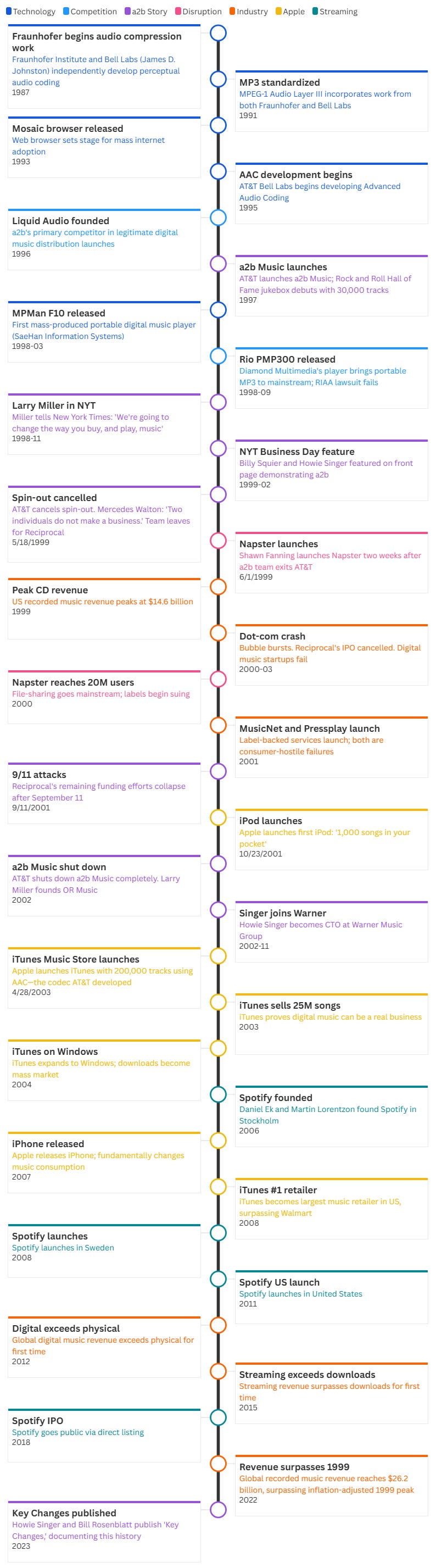
The Early Days: Building the Technology (1987-1997)
1987: The Fraunhofer Institute begins work on audio compression in Germany. Meanwhile, James D. Johnston at Bell Labs is developing perceptual audio coding algorithms.
1991: MPEG-1 Audio Layer III (MP3) is standardized, incorporating work from both Fraunhofer and Bell Labs. Johnston’s psychoacoustic contributions are essential but will be systematically underacknowledged for decades.
1993: The web browser Mosaic is released, setting the stage for mass internet adoption.
1995: AT&T Bell Labs begins developing what will become AAC (Advanced Audio Coding), building on Johnston’s perceptual coding research.
1996: Liquid Audio is founded in Redwood City, California. The company will become a2b’s primary competitor in legitimate digital music distribution.
1997: AAC is standardized as part of MPEG-2. AT&T launches a2b Music to commercialize the technology. The Rock and Roll Hall of Fame digital jukebox debuts with 30,000 tracks.
First Playback Devices and the Digital Music Market (1998-1999)
September 1998: Diamond Multimedia releases the Rio PMP300, one of the first mass-market portable MP3 players. The RIAA sues to block it; they lose. J.D. Heilprin runs RioPort, the services business associated with the Rio.
November 1998: Larry Miller tells the New York Times: “We’re going to change the way you buy, and play, music.”
February 1999: The New York Times features Billy Squier and Howie Singer on the front page of Business Day, showing a2b’s software demonstrating internet music delivery.
May 18, 1999: AT&T cancels the a2b spin-out. Singer, Miller, and twelve others leave for Reciprocal. Mercedes Walton tells the Wall Street Journal: “Two individuals do not make a business.”
June 1, 1999: Shawn Fanning launches Napster. The music industry is blindsided.
1999: US recorded music revenue peaks at $14.6 billion. It will not return to this level for two decades.
The File-Sharing Era (2000-2003)
March 2000: The dot-com bubble bursts. Reciprocal’s IPO is cancelled. Countless digital music startups fail.
2000: Napster reaches 20 million users. Grokster launches (Wayne Rosso, the former a2b consultant, eventually becomes its president). The labels begin suing file-sharing services.
2001: MusicNet (backed by Warner, EMI, BMG, and RealNetworks) and Pressplay (Universal and Sony) launch. Both are consumer-hostile failures. Napster is ordered to stop facilitating copyright infringement.
September 2001: Reciprocal is sold to Microsoft in an asset sale following 9/11.
October 23, 2001: Apple launches the first iPod. “1,000 songs in your pocket.”
December 2001: Rhapsody launches as the first on-demand streaming service with a large licensed catalog, offering unlimited streaming for a flat monthly fee. Limited by lack of wireless broadband and pre-smartphone mobile devices, it will limp along for years before rebranding as Napster in 2016.
Early 2002: Larry Miller founds OR Music, a record and publishing company that will find success with Los Lonely Boys. AT&T shuts down a2b Music completely.
April 28, 2003: Apple launches the iTunes Music Store with 200,000 tracks, using AAC, the codec AT&T developed and abandoned. Jobs gets the terms a2b never could.
The Rise of iTunes and Digital Downloads (2003-2008)
2003: iTunes sells 25 million songs in its first year. The RIAA begins suing individual file-sharers.
2004: iTunes expands to Windows, breaking open the mass market. Downloads become a real business.
2005: iTunes adds video. Podcasts enter the mainstream. YouTube launches.
2006: Spotify is founded in Stockholm by Daniel Ek and Martin Lorentzon. Amazon launches Unbox (video streaming).
2007: Apple releases the iPhone, fundamentally changing how people will consume music. Amazon MP3 launches, offering DRM-free downloads. Radiohead releases “In Rainbows” via pay-what-you-want download.
2008: Spotify launches in Sweden. iTunes becomes the largest music retailer in the United States, surpassing Walmart.
The Streaming Revolution (2008-2015)
2008: SoundCloud launches, enabling independent artists to share music directly.
2009: Rdio launches (it will shut down in 2015). Pandora files for IPO.
2011: Spotify launches in the United States. Apple launches iCloud and iTunes Match, acknowledging the shift toward cloud-based music.
2012: Global digital music revenue exceeds physical for the first time. Beats Electronics launches Beats Music streaming service.
2014: Apple acquires Beats Electronics for $3 billion, including Beats Music. Tidal is acquired by Jay-Z’s Project Panther, positioning it as an artist-owned alternative.
2015: Apple Music launches, integrating Beats Music technology. Jay-Z relaunches Tidal with high-profile artist backing. Streaming revenue surpasses downloads for the first time.
The Major Streaming Players Emerge (2015-Present)
2016: Amazon Music Unlimited launches, leveraging Prime subscribers. Deezer expands to 180+ countries. Rhapsody rebrands as Napster. US recorded music revenue begins growing again after 15 years of decline.
2017: Streaming becomes the dominant format, accounting for 65% of US music industry revenue.
2018: Spotify goes public via direct listing. YouTube Music launches as a dedicated streaming service.
2019: Qobuz launches in the United States, focusing on high-resolution audio. The global recorded music market reaches $20 billion, approaching pre-Napster levels for the first time.
2020: Pandemic accelerates streaming adoption. Tidal introduces hi-res streaming tiers.
2021: Spotify reaches 165 million paid subscribers. Apple Music introduces spatial audio with Dolby Atmos. Amazon Music adds hi-res streaming to standard subscription.
2022: Global recorded music revenue reaches $26.2 billion, surpassing the 1999 peak when adjusted for inflation. Streaming accounts for 67% of revenue.
2023: Suno and Udio launch AI-generated music services, facing the same copyright questions that defined the Napster era. Howie Singer and Bill Rosenblatt publish “Key Changes: The Ten Times Technology Transformed the Music Industry,” documenting this history.
2024-2025: The major streaming platforms (Spotify, Apple Music, Amazon Music, YouTube Music, Tidal, Qobuz, and Deezer) continue competing for subscribers. Artist compensation and AI-generated content become central industry debates.
The a2b story sits at the hinge point of this timeline: the moment between the technology being ready and the market being ready. AT&T had the codec that would power iTunes. They had the team that understood digital distribution. They killed the spin-out two weeks before Napster proved the demand existed. The technology survived and eventually won. The team was scattered. And the road from 1999 to today is, as Larry Miller puts it, paved with the husks of dead companies who had the music industry’s best intentions at heart.
Sources and Further Reading
Primary Interviews
Howie Singer, co-founder of a2b Music (January 2026)
Larry Miller, co-founder of a2b Music (January 26, 2026)
Ted Cohen, former VP of New Media, EMI (January 2026)
News Coverage (May 1999)
Wall Street Journal: “Founders of Digital-Music Unit At AT&T Leave for Reciprocal” (May 18, 1999) [link]
Tech Monitor: “Reciprocal Woos and Wins AT&T’s a2b Music Engineering Team” (May 18, 1999) [link]
Los Angeles Times: “A2B Founders Join Start-Up” by Jonathan Gaw (May 19, 1999)
Daily Variety: “Reciprocal Racing” by Adam Sandler (May 19, 1999)
Reuters: “Rival Hires Away Much of AT&T Online Music Team” by Nicole Volpe (May 18, 1999)
Earlier Coverage
New York Times: “Trying to Get in Tune With the Digital Age” by Jon Pareles (February 1, 1999)
New York Times: “In My...Satchel: Larry Miller” by David Cay Johnston (November 1, 1998) [gift link]
Books
“Key Changes: The Ten Times Technology Transformed the Music Industry” by Howie Singer and Bill Rosenblatt (Oxford University Press, 2023)
Online Resources
Larry Miller Expert Witness CV (2016)
ReallyRareWares: a2b Music Player (downloadable software and screenshot)
Internet Archive: a2b Music Website (1999)
Musonomics Podcast (Larry Miller)
Related
“The Other Father of MP3“ by Frans Keylard: the companion piece telling James D. Johnston’s story from the engineering side
Time for me to tell the tale of women being shut out of a2bmusic. As a senior MTS in AT&T Labs, my qualifications included an M.S. in electrical engineering from Caltech, an M.F.A. in composition from Princeton, and a composition recently performed at the International Conference on Computer Music in Hong Kong and in Japan. In addition to a strong background in Western classical music, I had a great deal of training in ethnomucology, including the music of India. (I guess no one was thinking about Bollywood at the time, so Indian music was considered a fringe topic.) I heard about a meeting for A2B music, but no one ever informed me or invited me, despite my qualifications. As a woman, I was never in the in-crowd. Women had been previously shut out of the big multi-universoty grant in computer music in 1981-82. I was too traditionally female to stand up for myself and fight back then. But this time I did what a woman in engineering had to do. I got dressed up in a beautiful outfit and quietly crashed the meeting. I think I was the only woman in the room. After that I spoke with Sandy Fraser and later met Mercedes. Of course a Black woman executive was going to advocate for a woman engineer, and she did. But there was one male chauvinist department head jerk (yes I will use that word) in AT&T Labs research (Not James Johnston or Larry Rabiner and not named in the above article) who, for some weird reason - since I had never met him before - was determined to keep me out of the project. On another occasion, I spoke to an executive at AT&T Labs about the possibility that TV news correspondents could upload their content onto the internet to transmit it to their stations. This was meant with puzzled expressions. I guess it was too futuristic. I regret that I have to be so negative, but I am totally fed up with how the doors closed and, in a female colleagues' words, "the ignoring and concealment of the qualifications of women."